GIS Developer - MA, Geography, University of Colorado, Boulder
Inquisitive Individual with Three Specialties
This website is dedicated to a summary of my work and research interests.
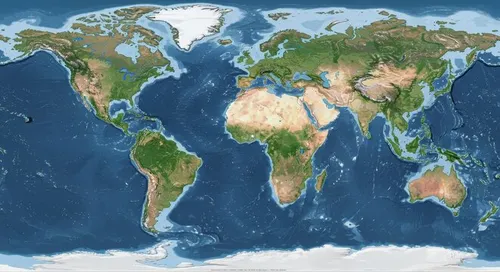
Geography
Space, Place, and Time
Data Science
Programming and Syntax
Physics
Matter, Energy, and Force
I graduated from Chaffey Community College in Rancho Cucamonga in 2015. It introduced me to the world of academic policy, statues and research. I majored in
a specialized AA that focused on material shared throughout the UC system in California. To be frank, I would have never considered this had I not
had an outstanding academic counsular at the time. They helped me navigate the entire UC system, and their knowledge aided me well beyond
undergraduate studies. After earning my AA, I applied, and was accepted, into the University of California, Santa Barbara in 2017. I spent 3 years
at UCSB and graduated in 2020 with a double major in Geography and Physics. My Geography degree came with a specialization in GIS, and I wanted to further
pursue it at the highest level. In 2021, I was accepted into the Geography department at CU, Boulder as a Master's student under Dr. Guofeng Cao at
STARlab.
Skills and Experience
Programming is like playing with Legos...
...but the instructions are often unclear
and each lego piece must be handmade.
As a multi-disiplinary scholar, I have been fortunate enough to be apart of many research projects over the last decade
that require many different types of bricks. There are many freely avaliable sources to help you and I build these.
Many of the resources contain everything there is to know about the language. As my understanding of them is rather...basic,
I thought I'd narrow down some helpful tutorials and include the kind of work that got me started in Academia:
Java
Object-Oriented Programming
Applications, Webkits, and GUIs
Python
Data Science and Automation
The premier machine learning language
R
The Statistician's Language
Easy, intuitive, and optimized for statistics
My thesis focused on surface ozone modeling. Using Google Earth Engine, EPA Air Quality Data, GitHub, and Python, I started the skeleton of an ML air pollution
model with geospatially corrected residuals trained on monitoring locations. The motivation for this can be seen in my early research projects and posters before I
started graduate school. Overall, I utilize a variety of programs to conduct spatial-temporal analyses in many disciplines:
Accomplishments and Interests
Blogs, Programs and Additional Works
Multi-Disiplinary Research
A World of Infinite Possibilities
As I began developing a passion for GIS programming, I faced significant challenges with my physical and mental health, which led me to extend my graduate studies by two years to focus on recovery and growth. With several awarded funding opportunities, I was able to continue expanding my thesis and multidisciplinary skill set. During this time, I collaborated with prominent researchers who helped refine my technical and analytical abilities.
I had the pleasure of working with NC CASC as a CEST member to research a topographic signature of life. I wrote blog detailing it's
importance and furture directions. This was part of a program called the Climate Adaptation Scientists of Tomorrow which funded my
final semester at CU.
The FIRe Event Delineation tool (FIREDPY) created by Earth Lab at CU. I was briefly apart of some summer work that fixed some edge-case
issues on the program. It's classifies individual burn detections into discrete events for further analysis (Balch et. al., 2020).
This will take you to an excerpt from my thesis. I only included the first three chapters After focusing on the
machine learning and geostatistical applications of my work, I hope to apply my findings to more human centric
research.
Eventually, this will take you to a GitHub that I created to begin translating my script into a more user friendly function.
For now, this will take you to my thesis excerpt.
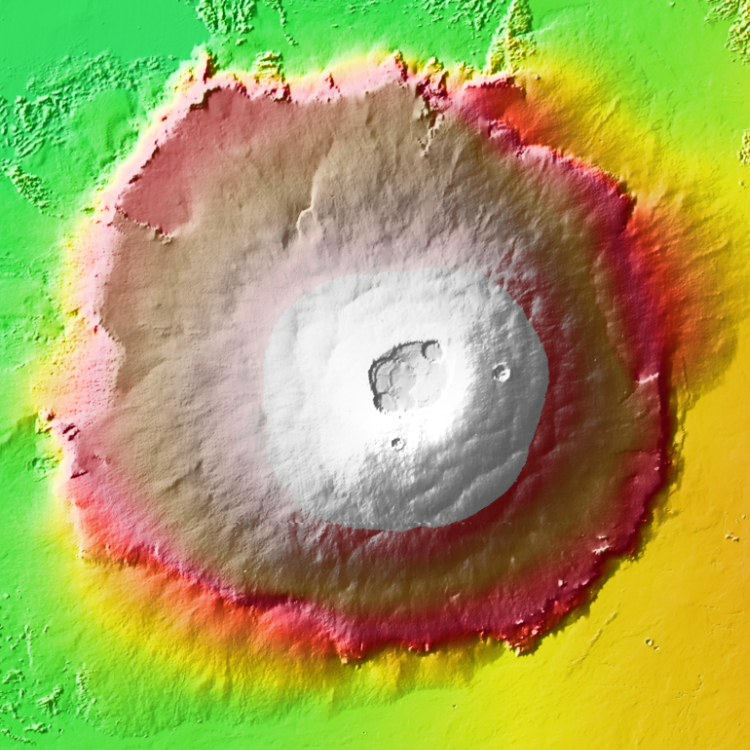
A potential biosignature is a substance or structure that might have a biological origin but requires
more data or further study before reaching a conclusion about the absence or presence of life. Do they
exist? If so, can we detect them in the topographic scape of Earth?
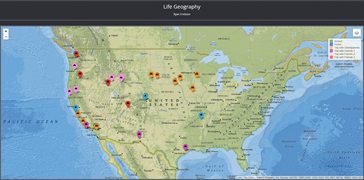
As my network and social life grows, I hope to expand this map with more international points. Most of the road trips I've taken have been
across the contiguous US with my Grandparents. Some of my favorite places and future destinations are on it as well!